Read a diagnostic result
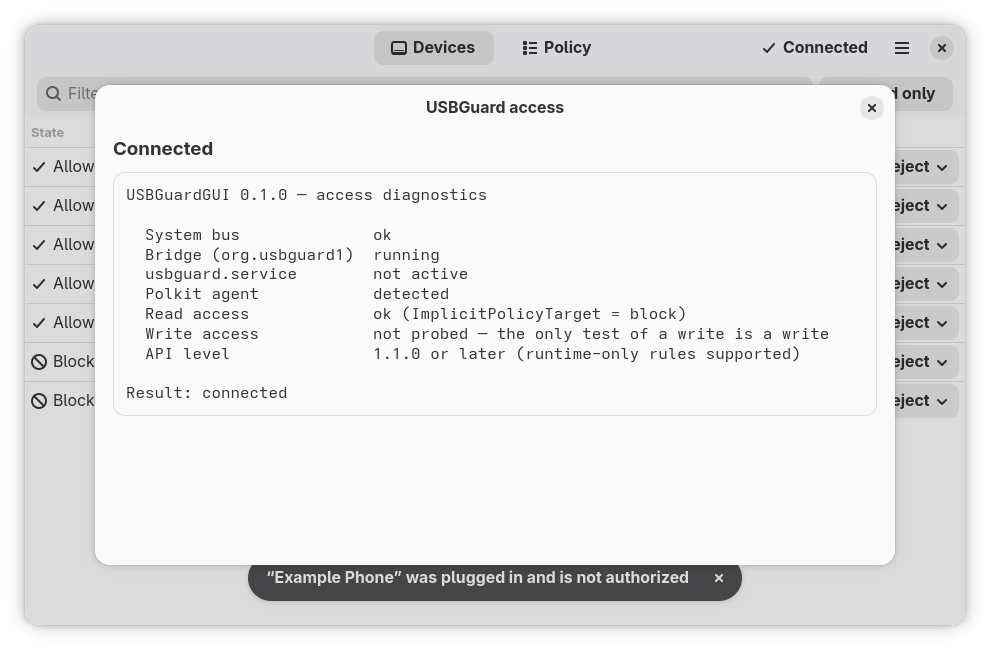
usbguard-gui --diagnose — or the connection indicator in the window's header bar — reports one of
these states. A request to USBGuard crosses three independent checkpoints, each enforced by a
different component: the D-Bus bus policy, then Polkit, then USBGuard's own IPC access
control. The states say which one refused.
| Result | Exit code | Meaning | Remedy |
|---|---|---|---|
connected |
0 | Everything works. Writes are not tested in advance — the only test of a write is a write. | — |
no system D-Bus |
5 | There is no system bus in this session — usually a container or sandbox. | Run on the host, or give the sandbox system-bus access. |
the USBGuard D-Bus bridge is not installed |
4 | The package that provides org.usbguard1 is missing. |
Install the D-Bus bridge. |
the USBGuard D-Bus bridge is not running |
4 | Installed, but its service is stopped. | Start it. |
denied by the D-Bus bus policy |
3 | The bus refused the message before it reached USBGuard. A Polkit rule cannot fix this. | An administrator must change org.usbguard1.conf. |
denied by Polkit |
3 | Polkit refused — or the password prompt was cancelled. | Try again, or see Change policy with your own password. |
no Polkit authentication agent is running |
3 | A password was needed and nothing could ask for it. | Start your desktop's Polkit agent. |
denied by the USBGuard IPC access control |
3 | USBGuard's own access control refused. The bridge normally satisfies it as root, so an administrator has narrowed it deliberately. | sudo usbguard add-user …, as --diagnose prints. |
access denied |
3 | Refused, and the refusing layer could not be identified. | --diagnose lists every applicable remedy. |
Exit codes let scripts branch without parsing text:
usbguard-gui --diagnose >/dev/null
case $? in
  0) echo "ready" ;;
  4) echo "install or start usbguard-dbus" ;;
  3) echo "permissions" ;;
esac
Why writes are never probed
Checking whether you may change the policy would mean changing the policy. The first real action you take carries that test, and a refusal is reported there, in its own context.